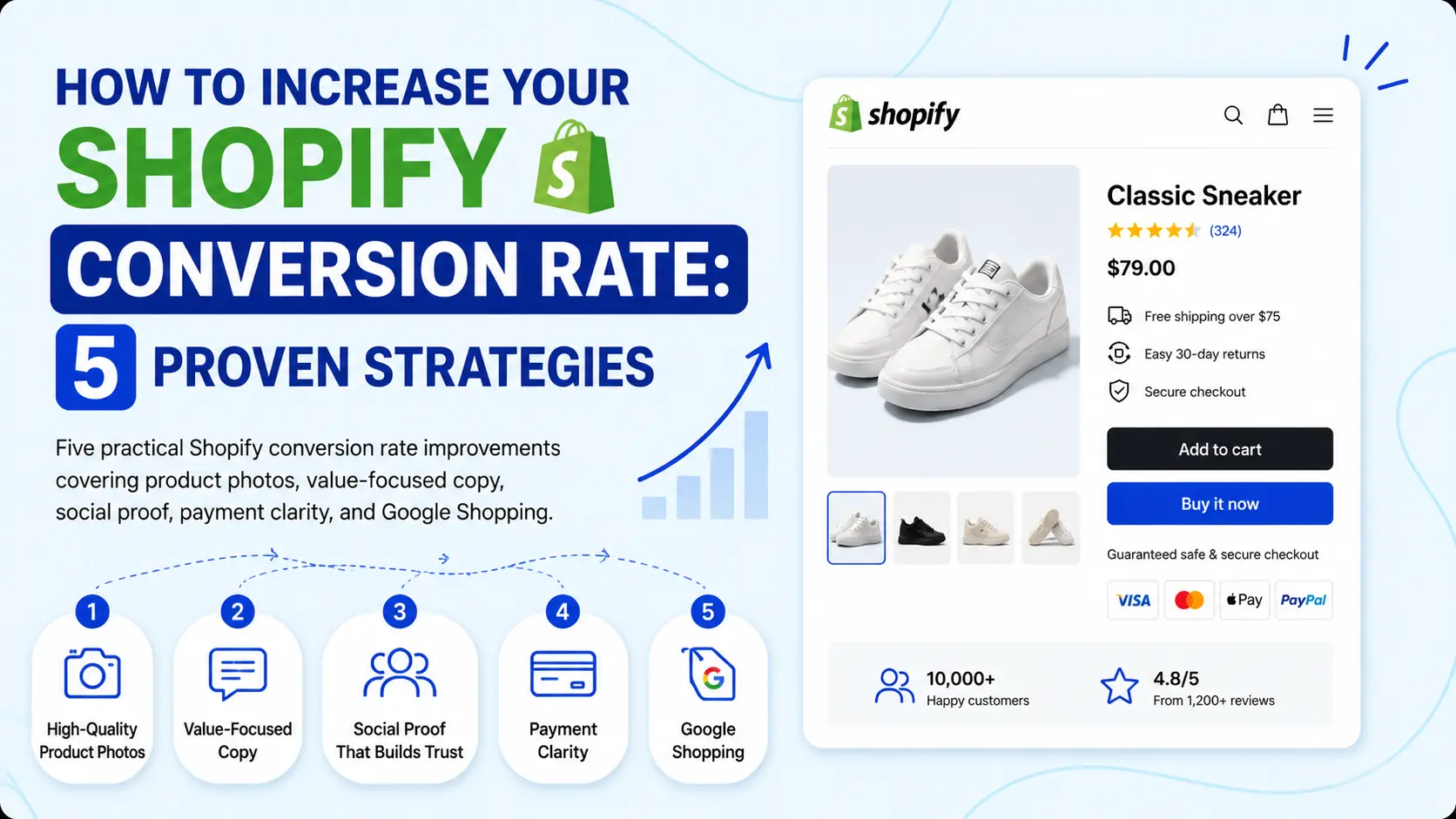
If you're driving traffic to your Shopify store but not seeing sales, you're not alone. The average ecommerce conversion rate hovers around 1–3%, which means the majority of your visitors are leaving without buying. The good news? Shopify conversion rate optimisation doesn't require a full redesign or a big budget — small, targeted changes to your product pages can make a significant difference.
Here are five proven strategies to improve your Shopify conversion rate starting today.
1. Upgrade Your Product Photos
In a physical store, customers can pick up and examine products before buying. Online, your photos have to do that job. High-quality imagery is one of the single biggest factors in whether a visitor decides to trust you enough to purchase.
To improve your Shopify conversion rate through photography:
- Include at least 3 high-resolution photos per product
- Show your product in real-life context — if you sell clothing or accessories, use photos of real people wearing them in natural settings
- Add at least one size-comparison photo so customers can understand scale
- Convert your images to WebP format, which reduces file size by up to 35% compared to JPG without sacrificing quality — faster loading means fewer abandoned pages
Poor or generic product photos are one of the most common reasons customers hesitate. A clear, professional image library signals trustworthiness and helps customers visualise owning the product.
How to optimize product photos? Glad you asked, we have built a free tool for this. The tool lets you compress the images to webp format without loosing quality. That means they will load faster and boost both your conversion rate and SEO ranking. You can check it out here for free
2. Write Product Descriptions That Focus on Value, Not Specs
Most product descriptions make the same mistake: they list features and technical specifications instead of explaining what the product actually does for the customer.
A spec-heavy description tells shoppers what something is. A value-focused description tells them why they need it — and that's what converts.
Weak example: "48MP camera with 2x optical-quality telephoto zoom." Stronger example: "Capture stunning detail up close or far away, so you never miss a moment worth remembering."
When writing your descriptions, picture your ideal customer. What vocabulary are they comfortable with? What problem are they trying to solve? What questions might they have? Answer those questions directly in your copy, and you'll not only improve conversions — you'll also pick up organic search traffic from people typing those exact questions into Google.
3. Add Social Proof Throughout Your Product Pages
Social proof is one of the most powerful psychological tools available to any ecommerce store. When potential buyers see that other real people have purchased and enjoyed your product, it significantly lowers their hesitation.
Here's how to use social proof effectively on Shopify:
Customer reviews — Display your review summary (star rating + review count) directly beneath the product title, so it's one of the first things shoppers see. To collect more reviews, send an automated follow-up email a few weeks after purchase asking customers to share their experience. Most happy customers won't bother to review unprompted — this one step alone can dramatically improve your review volume.
Proof of demand — Show how many units have been sold recently (use rounded numbers like "500+ sold" rather than exact figures to avoid revealing data to competitors). If your product is low in stock, display it — genuine scarcity creates urgency. Just don't fabricate it; customers notice.
Trust badges — Labels like "Bestseller," "Highly Rated," or "Featured in [Publication]" add credibility at a glance and reinforce buying confidence.
4. Display Payment Options and Shipping Info Up Front
Uncertainty about payment and delivery is a silent conversion killer. Customers who aren't sure whether their preferred payment method is accepted — or how long delivery will take — are far more likely to abandon the page.
To address this:
- Show accepted payment methods (including buy-now-pay-later options like Klarna or Afterpay) directly below your Add to Cart button
- Display stock availability and estimated delivery dates prominently — even a general range like "Ships in 3–5 business days" is better than nothing
- Include return policy information on the product page itself — many customers actively look for this before buying, and you don't want them leaving your page to find it
These are small additions that create big reassurance for first-time buyers.
5. List Your Products on Google Shopping (It's Free)
Many Shopify store owners overlook Google Shopping entirely, assuming it requires ad spend. In fact, the organic (free) listings on Google Shopping can drive meaningful additional traffic to your product pages with zero ongoing cost.
To get listed, connect your Shopify store to Google Merchant Center using the free official Google app for Shopify. Once your product feed is approved, your items can appear in Google search results when shoppers are looking for what you sell.
One underused tip: use a non-white product background image in your Google Shopping feed. The vast majority of competitors use plain white backgrounds — a product photo with a coloured or lifestyle background stands out immediately and can meaningfully improve click-through rates.
Frequently Asked Questions
What is a good conversion rate for a Shopify store? Most Shopify stores convert at 1–3%. Anything above 3.5% is considered strong. If you're below 1%, focus on trust signals and product page quality first.
How long does it take to see results from CRO changes? Some changes — like adding reviews or payment icons — can show results within days. Others, like building up a review library, take weeks or months of consistent effort.
Do I need a developer to improve my Shopify conversion rate? Not necessarily. Many of the improvements above can be made directly in your Shopify theme editor or through free/low-cost apps without touching code.
Shopify conversion rate optimisation is an ongoing process, not a one-time fix. Start with the changes that are easiest to implement — better photos, clearer descriptions, and visible social proof — and build from there. Even a 1% improvement in conversion rate can translate into a significant lift in revenue without spending a single extra dollar on advertising.