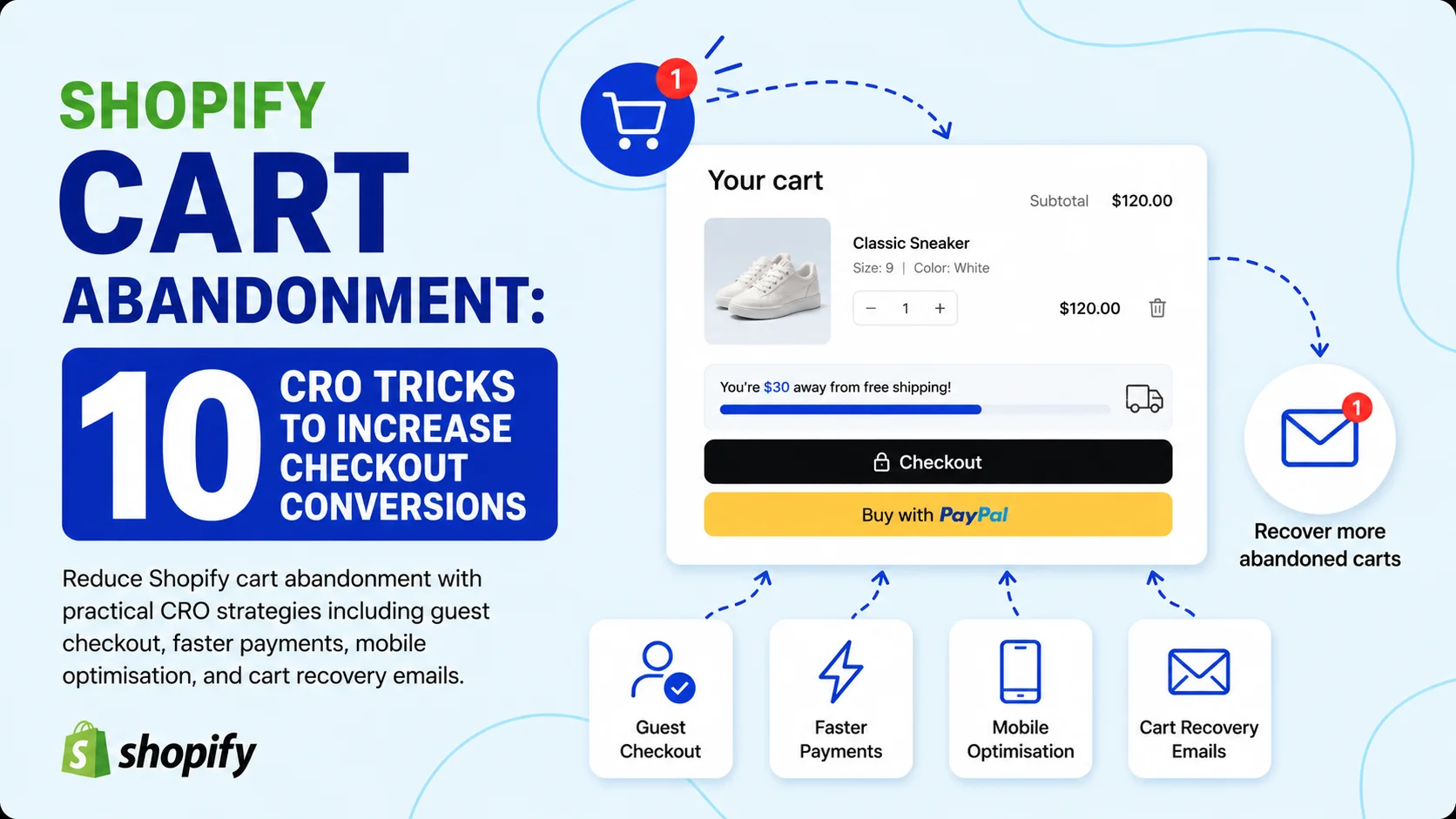
Even with modern ecommerce platforms like Shopify, cart abandonment remains one of the biggest revenue leaks for online stores.
Customers browse products, add items to their basket, begin checkout — and then leave without completing their purchase.
In many cases, this does not happen because shoppers lose interest. Instead, abandonment is often caused by friction during the buying journey, including:
- Unexpected shipping costs
- Slow or complicated checkout experiences
- Mobile usability problems
- Limited payment methods
- Lack of trust signals
- Forced account creation
For Shopify store owners, improving checkout conversion rates often comes down to small but strategic Conversion Rate Optimisation (CRO) improvements.
The good news is that Shopify already includes several built-in features designed to reduce abandonment, including Shop Pay, accelerated checkout options, abandoned checkout recovery, mobile-first checkout optimisation, and flexible payment integrations.
Below are 10 proven CRO tactics that help reduce Shopify cart abandonment and improve completed checkout rates.
What Is Shopify Cart Abandonment?
Shopify cart abandonment happens when a shopper adds products to their basket but leaves the site before completing checkout.
There are two common stages:
- Cart abandonment — users leave before starting checkout
- Checkout abandonment — users begin checkout but fail to complete payment
This is extremely common in ecommerce.
Mobile shoppers are particularly likely to abandon because smaller screens, distractions, slower load times, and payment friction create additional barriers.
Understanding how Shopify reduces cart abandonment starts with identifying where friction appears in the customer journey.
Why Shopify Stores Experience High Cart Abandonment Rates
Even well-designed Shopify stores can struggle with abandonment because online shoppers make fast emotional decisions.
Some of the most common causes include:
- Surprise shipping fees
- Long checkout forms
- Slow mobile checkout experiences
- Limited payment options
- Lack of delivery clarity
- Weak trust signals
- Complicated navigation
- Forced account registration
Reducing these friction points can dramatically improve Shopify checkout conversion performance.
1. Remove Surprise Costs Early
Why It Matters
Unexpected costs are one of the biggest drivers of Shopify cart abandonment.
When taxes, shipping fees, or handling costs appear late in checkout, shoppers experience “price shock,” which interrupts purchase momentum.
Users mentally commit to a price before checkout begins. If the final total suddenly increases, many abandon immediately.
Shopify CRO Tactic
Display pricing transparency as early as possible.
Best Practices
- Show estimated shipping costs on product pages
- Add shipping calculators inside the cart
- Clearly communicate free shipping thresholds
- Display estimated taxes upfront
- Avoid hidden fees entirely
Example
Instead of:
“Shipping calculated at checkout”
Use:
“Free delivery over £50. Estimated shipping: £4.95”
How Shopify Reduces Cart Abandonment Here
Shopify apps and checkout customisations make it easy to display shipping estimates, delivery windows, and free shipping progress bars directly inside the shopping experience.
This reduces uncertainty and keeps users moving toward purchase completion.
2. Add Guest Checkout to Reduce Shopify Cart Abandonment
Why It Matters
Forced account creation creates unnecessary friction.
Many shoppers simply want to complete a purchase quickly without creating an account, setting passwords, or verifying emails.
The more steps users encounter, the higher the abandonment risk becomes.
Shopify CRO Tactic
Make guest checkout highly visible.
Best Practices
- Prioritise guest checkout
- Allow account creation after purchase
- Avoid mandatory registration
- Minimise login interruptions
- Keep checkout steps linear
Better Checkout Structure
1. Shipping details 2. Delivery method 3. Payment 4. Confirmation
Instead of:
1. Create account 2. Verify email 3. Set password 4. Continue checkout
Psychological Principle
Reducing perceived effort lowers resistance.
Simpler checkouts feel faster, easier, and safer.
3. Optimise Shopify Checkout for Mobile First
Why It Matters
Most ecommerce traffic now comes from mobile devices, yet many checkouts still feel desktop-focused.
Tiny form fields, excessive scrolling, slow page speed, and awkward typing experiences all increase abandonment.
Shopify CRO Tactic
Design checkout specifically for mobile behaviour.
Best Practices
- Use large touch-friendly buttons
- Enable autofill and address lookup
- Use numeric keyboards for card fields
- Minimise required form fields
- Add sticky checkout buttons
- Reduce distractions
Quick CRO Wins
Remove unnecessary fields such as:
- Company name
- Second address line
- Fax number
- Optional survey questions
How Shopify Reduces Cart Abandonment on Mobile
Shopify’s mobile-first checkout and Shop Pay accelerated checkout help reduce typing, streamline payments, and speed up conversions.
Wallet-based payment systems dramatically reduce friction because users avoid manually entering payment information.
4. Use Exit-Intent Recovery Offers
Why It Matters
Not every abandoning visitor has lost buying intent.
Some shoppers become distracted, uncertain, or price-sensitive before checkout completion.
Exit-intent interventions can recover a percentage of these users before they leave.
Shopify CRO Tactic
Trigger targeted recovery messaging.
Examples
- First-order discounts
- Free shipping reminders
- Live chat offers
- Low-stock reminders
- Email capture popups
Example Messaging
“Wait — complete your order today and enjoy free delivery.”
Best Practices
- Avoid aggressive popups immediately after page load
- Keep messaging short
- Focus on benefits
- Test incentives carefully to protect margins
Psychological Principle
This tactic leverages urgency and loss aversion.
People dislike losing potential value more than they enjoy gaining it.
5. Build Trust Throughout the Shopify Checkout Flow
Why It Matters
Trust anxiety increases dramatically near payment stages.
Shoppers hesitate when they question:
- Payment security
- Delivery reliability
- Return policies
- Brand legitimacy
Shopify CRO Tactic
Reinforce trust signals throughout checkout.
Best Practices
- Display SSL and security badges
- Show customer reviews near checkout
- Add visible return policies
- Include delivery estimates
- Provide contact details
- Use recognisable payment logos
High-Converting Payment Methods
- Shop Pay
- Apple Pay
- Google Pay
- PayPal
- Credit/debit cards
Important UX Insight
Trust signals work best when contextual.
For example:
- Security messaging near payment fields
- Returns messaging near checkout CTAs
- Delivery reassurance near shipping options
6. Simplify the Checkout Flow
Why It Matters
Complex checkouts increase cognitive load.
Users should always understand:
- Where they are
- What comes next
- How many steps remain
Confusing checkouts increase frustration and abandonment.
Shopify CRO Tactic
Reduce unnecessary complexity.
Best Practices
- Use progress indicators
- Remove distracting navigation
- Keep checkout linear
- Collapse optional sections
- Avoid opening new tabs
Better UX Approach
Instead of overwhelming users with every form at once, progressively reveal checkout steps.
Psychological Principle
Clear progression reduces uncertainty.
The simpler the process feels, the more likely users are to complete it.
7. Create Urgency and Scarcity Carefully
Why It Matters
Many shoppers delay purchases when there is no reason to act immediately.
Ethically applied urgency can increase conversion speed and reduce procrastination.
Shopify CRO Tactic
Use genuine urgency messaging.
Examples
- “Only 3 left in stock”
- “Order within 2 hours for next-day delivery”
- “Sale ends tonight”
- “Popular item — selling quickly”
Important Warning
Avoid fake countdown timers or misleading scarcity.
Dark patterns may increase short-term conversions but damage long-term trust.
Psychological Principle
Scarcity increases perceived value while urgency reduces hesitation.
8. Improve Cart Persistence Across Devices
Why It Matters
Not all abandonment means lost intent.
Many users:
- Switch devices
- Compare prices
- Get distracted
- Return later
If their basket disappears, frustration increases significantly.
Shopify CRO Tactic
Enable persistent carts.
Best Practices
- Save basket contents automatically
- Preserve carts across sessions
- Sync carts across devices
- Retain coupon codes
- Send reminder emails
Returning User Messaging
“Your basket is waiting for you.”
This creates continuity and reduces friction for returning shoppers.
9. Optimise Payment Methods
Why It Matters
Payment friction is one of the biggest causes of checkout abandonment.
Users expect fast, flexible payment options.
If preferred methods are unavailable, many abandon instantly.
Shopify CRO Tactic
Offer accelerated and flexible payment solutions.
Best Practices
- Enable Shop Pay
- Add Apple Pay and Google Pay
- Offer PayPal Express
- Support Buy Now Pay Later carefully
- Reduce manual card entry
- Enable one-click checkout for returning users
How Shopify Reduces Cart Abandonment With Shop Pay
One of Shopify’s biggest conversion advantages is Shop Pay.
Shop Pay stores customer details securely, enabling dramatically faster repeat purchases.
Benefits include:
- Faster checkout completion
- Reduced typing on mobile
- Higher returning customer conversion
- Lower friction during payment
For mobile shoppers especially, accelerated checkout can significantly improve conversion rates.
10. Use Shopify Abandoned Cart Email Sequences
Why It Matters
Many shoppers simply need a reminder.
Abandoned cart emails remain one of the highest-performing ecommerce recovery channels available.
Shopify CRO Tactic
Build automated abandoned checkout flows.
Recommended Sequence
Email 1 — Reminder (1–3 Hours)
Simple reminder with product image and CTA.
Email 2 — Reinforcement (24 Hours)
Highlight:
- Product benefits
- Reviews
- Delivery speed
- Scarcity
- Social proof
Email 3 — Incentive (48–72 Hours)
Offer:
- Free shipping
- Small discount
- Bonus incentive
Best Practices
- Keep emails visually simple
- Use strong product imagery
- Add direct return-to-cart links
- Optimise for mobile
- Personalise where possible
Example Subject Lines
- “You left something behind”
- “Still thinking it over?”
- “Your basket is waiting”
Additional Shopify CRO Quick Wins
Beyond the major strategies above, several smaller UX improvements can further reduce Shopify cart abandonment.
Additional Optimisations
- Add live chat during checkout
- Improve checkout page speed
- Reduce popup overload
- Add sticky cart buttons
- Improve product page trust signals
- Display customer reviews prominently
- Use progress bars during checkout
- Simplify coupon code entry
Small improvements compound over time and often produce measurable gains in conversion performance.
How Shopify Reduces Cart Abandonment Better Than Many Ecommerce Platforms
Shopify includes several built-in features specifically designed to improve checkout conversion rates.
Key Advantages
- Shop Pay accelerated checkout
- Mobile-first checkout optimisation
- One-page checkout improvements
- Built-in abandoned checkout recovery
- Flexible payment integrations
- Fast site performance
- Extensive CRO app ecosystem
Combined, these features help Shopify stores reduce friction throughout the customer journey.
However, even the best ecommerce platform still requires strong UX, CRO strategy, and checkout optimisation to maximise conversions.
Final Thoughts
Reducing Shopify cart abandonment is rarely about redesigning your entire store.
In most cases, higher conversion rates come from removing friction at critical moments in the buying journey.
Small CRO improvements such as:
- simplifying checkout,
- improving mobile UX,
- increasing trust,
- reducing surprise costs,
- and optimising payment methods
can collectively produce significant revenue gains over time.
The brands that consistently improve conversion rates are usually the ones that continuously refine their checkout experience based on customer behaviour.
Frequently Asked Questions
What is the average Shopify cart abandonment rate?
Most Shopify stores experience cart abandonment rates between 67% and 75%, depending on device type, pricing, industry, and checkout complexity.
Why do customers abandon Shopify checkouts?
The most common reasons include unexpected shipping costs, forced account creation, payment friction, slow mobile checkout experiences, and lack of trust signals.
How does Shop Pay reduce cart abandonment?
Shop Pay speeds up checkout by securely saving customer payment and shipping information, reducing friction and making repeat purchases significantly faster.
What is the best way to reduce cart abandonment on Shopify?
The most effective strategies include simplifying checkout, improving mobile UX, offering flexible payment methods, building trust signals, and using abandoned cart recovery emails.
Are abandoned cart emails still effective in 2026?
Yes. Abandoned cart email sequences remain one of the highest-performing ecommerce recovery channels when properly timed and personalised.
Does mobile checkout increase cart abandonment?
Yes. Mobile shoppers abandon more frequently because mobile checkout experiences often involve more friction, slower input, and higher distraction levels. Optimising for mobile-first checkout is essential for improving conversions.